"Getting a sound is about conception and practice. Making a guitar speak is all about how you touch the instrument and it requires years of dedication. It is a life’s work and I am still on the quest..."
In this section of the website, you'll find answers to some frequently asked questions, tips for keeping Stratocasters in tune, information about my live gear, plus track-by-track rundowns of the gear used on my CDs and about the writing and recording of the tunes.
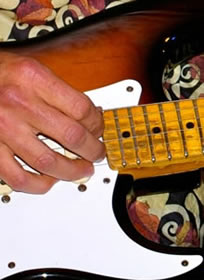
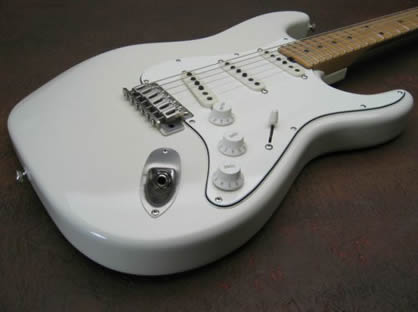
- Fender Stratocasters
- D'Pergo Signature Limited JK Edition
- D'Pergo Julien Kasper model
- Gibson Les Paul (‘58 reissue)
- Gibson Korina SG
- Gibson Les Paul Deluxe with P-90 pickups
- Fender Telecaster
- Martin OO-18 acoustic
2010 Live Pedal Board in Order of Signal Flow
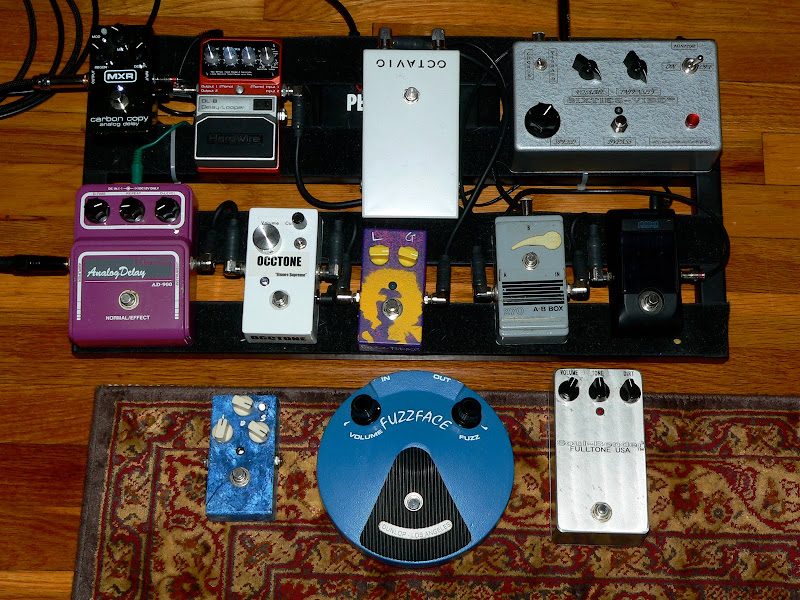
Current live pedals
Signal flow:
MJM '60s Vibe > Korg tuner > passive A/B switcher.
"A" side goes to:
Dunlop Octavio > JAM Fuzz Phrase > Occtone Elmore Supreme boost > Maxon AD900 analog delay > overdrive amp.
"B" side goes to:
Digitech Hardwire Delay set to reverse delay > MXR Carbon Copy analog delay > clean amp.
When I'm using bigger amps for the overdrive sound the Fuzz Face, which was custom made for me by Jeorge Tripps, is substituted for the JAM fuzz. If I don't have tremolo on one of my amps I'll add the JAM Chill pedal. The Fulltone Soulbender gets added occasionally. It is the "I am a Centaur" fuzz.
Not shown is the JAM Waheko wah which is in frequent rotation.
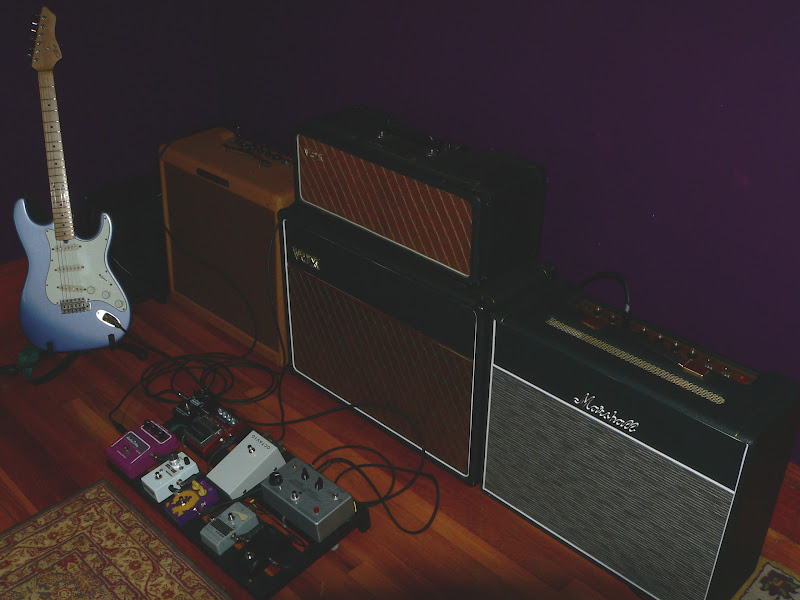
I prefer simple low gain vintage amps without master volumes, channel switching, or reverb. I still record with big high wattage vintage Marshalls but I rarely gig with them as the volume curve in just about every venue has dropped so dramatically.
For specific amps used on my CDs see the pages Tracking Flipping Time, Tracking The New Imperial, and Tracking Trance Groove.
My live set up has changed since recording “Trance Groove.” The new material has a broader array of pure clean textures so I have converted to a two amp rig which consists of either a Vox AC10 or Marshall 1974x 18 watt combo for the overdrive sounds and either a Vox AC30, a modified Fender Bassman, or a Fender tweed Bandmaster for the clean sounds. The AC10 and the Bandmaster tend to match up well in volume as do the 18 watt Marshall and the AC30 or Bassman but I frequently mix and match the various combinations. See the pedals page for my signal path.
For practicing I use a tweed Fender Champ that I pulled out of somebody's rubbish!
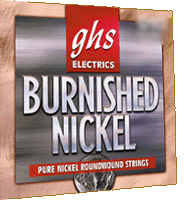
GHS Burnished Nickel Roundwound .011-.050.
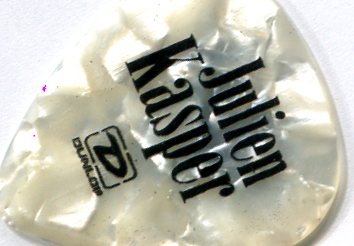
Dunlop Pearloid Extra Heavy. I like a heavy pick that gives positive contact with the strings and is very responsive to slight changes in angle for timbre variations.
I use a combination of Mogami and George
L’s on my pedalboard and Dimarzio Steve Vai cables
as my leads from the guitar to the pedals and the pedals to the amp.
While the George L’s are very transparent due to such low capacitance, they tend to be bright with a loose low end. Combining
them with the smoother midrange, slightly attenuated highs and tighter lows of Mogami cables works well for me for the short
runs on the pedalboard.
The Dimarzio Vai cables are the nicest sounding and quietest new cables I have tried. You can really hear the wood in your guitar and the air around the notes, I can’t praise them highly enough!
Keeping Stratocasters in Tune
From: Dennis M.
".... what is up with your intonation? Jeez, we saw you up in Portsmouth, NH, and you were winging the daylights
out of that Strat, and then playing tightly voiced chords, and everything was in tune....
I get quite a few comments on how well my Strats stay in tune and my answer is usually something like “I’m lucky tonight” or “It’s an illusion.” I’m sure many more of you have seen me constantly tuning throughout the evening. However, when the stars line up, my guitars do stay in tune fairly well so I’ll share a few hints with you.
The two main concerns with whammy bar usage are friction and balance.
To avoid friction:
- Be sure your nut slots are properly filed to support, but not bind, your string gauge. This should be done by a qualified guitar tech.
- Keep your bridge saddles clean and free of grooves.
- Make sure your strings pull straight over the nut to the tuners.
- Use a neat and efficient means of securing your strings. Every guitar tech seems to have their own idea about this. I use the vintage “safety post” style tuners and just wind the strings straight down for the low wound strings. On the unwound strings I wrap one turn above and the rest below with quite a few wraps on the G string to give adequate downward pressure over the nut for clear tone. Locking tuners can be nice but they will change the mass at your head stock and, therefore, your tone.
- Do not use a string tree for your G and D strings.
- Use a spacer below the string tree on the high E and B strings.
- Some people use a dry lubricant in the nut and bridge. Though it can help, I usually avoid this as the lubricants can discolor the finish of your instrument, especially if it is old and thin.
Balance:
Balance refers to the equalization of tension between your string gauge and the springs in the tremolo mechanism. In my experience there is no right way to achieve this. Every guitar seeks its own level and the amount of range you desire is dictated more by the individual guitar then any set formulae.
There are also different tensions of individual springs, some of which are more suited to certain systems. For example the low tension black trem springs are typically used in the two pivot “American Standard” style systems while higher tension silver springs (there are several variations) are used in the “vintage” six pivot bridge.
Though the two pivot systems function better mechanically I use vintage six pivot systems because they sound superior. The height of the pivot screws is critical - too high and the bridge will travel vertically and adversely effect the tone of the guitar because of reduced contact with the body, too low and it will bind and pull at the screws, creating tuning issues and eventually stripping the holes.
For my floating trem guitars I set the up pull range around a Major 2nd on the low E string as starting point. My string gauges are .011 -.050 so I use four of the heavier springs.
One of my Strats is set flush for no up pull. On that guitar I use three springs set very tight which seems to make that particular guitar ring better
I find that my floating tremolo guitars hold tune better than the one that is set flush - not the result most people would expect.
Warming up on the guitar with some good string bending and whammy bar stuff helps too. Letting the instrument sit for just a little while causes just enough corrosion to lightly bind the strings to any metal part they come in contact with so a little playing helps to loosen those points.
Good luck and keep experimenting.
— Julien
Guitars, Amps, Effects used on Trance Groove
Trance Groove
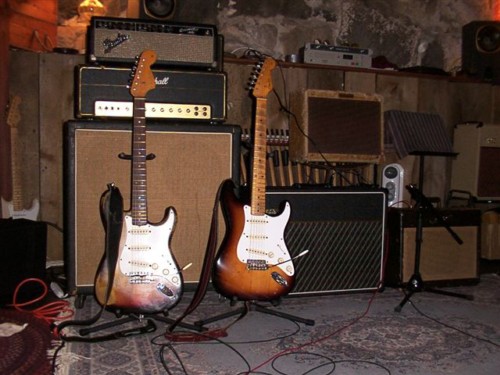
Live Track (solos, B and C sections): D’Pergo AVC Limited Strat (swamp ash) into a Roy Goode modified ’67 Fender Bassman head (EL 34 tubes, class A, cathode bias) and a ’69 Marshall 4x12 cabinet. This track was re-amped through a Leslie cabinet for the second half of the A section melody and the C section.
A section melody: Gretsch 6120 through a JAM Waterfall chorus and a Tech 21 Delay into a ’62 Fender Princeton.
Chordal textures and washes: D’Pergo Strat through Maxon AD-900 and Tech 21 delays into a ’57 Fender Deluxe, Gibson Korina SG into the ’62 Princeton. All of the textures were improvised.
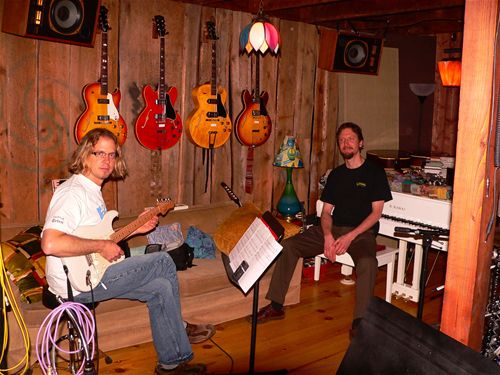
Getting ready to record Trance Groove (the tune)
Chupacabra
Live track: melody – Vintage Fender Stratocaster into a ’64 Vox AC10 amp.
Solo – same Fender Strat through a custom Jeorge Tripps/Dunlop Fuzz Face into a ’72 Marshall Super Lead and two vintage 4x12 cabinets (the ’69 and a ’72).
An MXR Carbon Copy delay was added to the live track and the solo for the improvised chordal intros to both.
The Reverend
Written for my friend and musical mentor Pat Ramsey.
Live Track - D’Pergo Signature Limited Strat (alder, no truss rod) into a ’64 Vox AC10 amp plugged into the vibrato (EF-86) channel on “10.” The AC10 is a 12 watt head with a 2x10 closed back cabinet.
Trash Day
Live Track - Vintage Fender Stratocaster through Jeorge Tripps/Dunlop Fuzz Face into a ’72 Marshall Super Lead on “8” and the two vintage Marshall 4x12 cabinets. I always use only the number 1 bright input on my Marshalls.
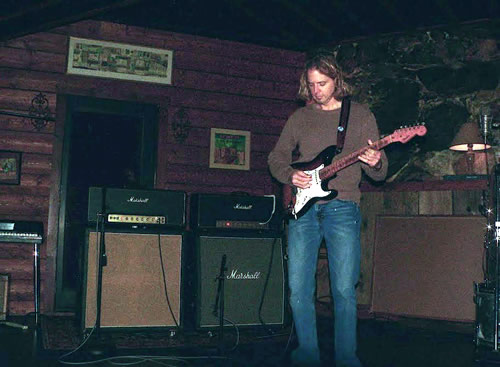
Getting (extremely loud) tones for Trash Day
Abyssinia
Written for my Abyssinian cat Camillia.
We recorded this tune live with the electric guitar so we could capture the interaction of the band during the solo. I returned to the studio later to replace the electric guitar with acoustic on the melody sections.
Acoustic – ’67 Martin 0018.
Electric/live track - D’Pergo AVC Limited Strat into the Fender Bassman head and the’69 Marshall 4x12 cabinet.
Milk Truck
Dedicated to my friend Bryan Hopkins.
Live track: melody - Gibson Korina SG through an Occtone Elmore boost into ’68 Marshall 50watt tremolo head on “10” and the ’69 Marshall 4x12 cabinet.
Solo - Vintage Fender Stratocaster through an Occtone Elmore boost into a ’72 Marshall Super Lead on “10” and the two Marshall 4x12 cabinets.
The Bumpus
Dedicated to my friend Jack Pfeil.
Live Track – ’72 Les Paul Deluxe Gold Top with P-90 pickups into the Vox AC10.
Textures and chord overdubs – D’Pergo Signature Limited through the MXR Carbon Copy Delay into the Vox AC10. The backwards sounds are the original live melody flipped end to beginning and edited for the choice parts. This lined up miraculously well. All additional textures were improvised.
Riff 53
Live Track – ’68 Les Paul Gold Top with P-90 pickups into a ’64 Vox AC30 amp. The amp was on “10” and I was plugged into the normal channel.
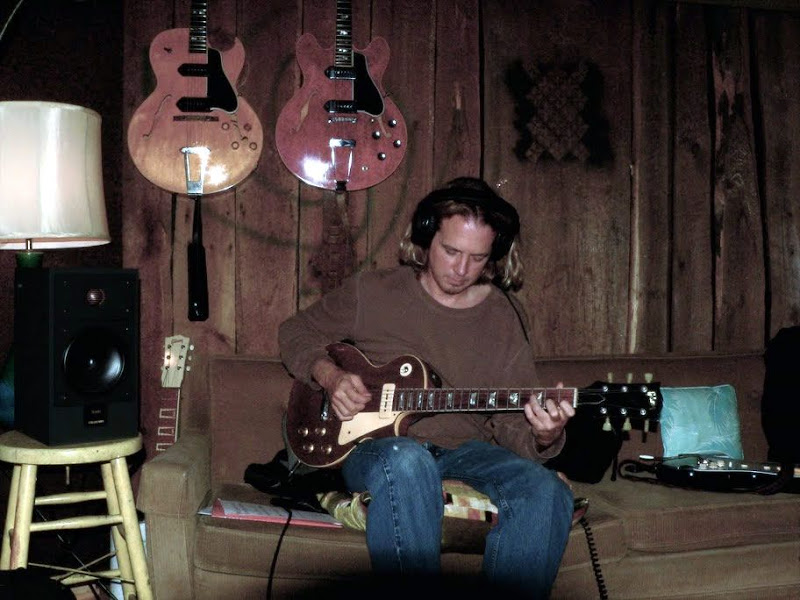
Recording Riff 53
Carolina Rosa
This group improvisation is dedicated to my Grandmother Rosa Lumpkin.
Live Track – D’Pergo Aged Vintage Classic through JAM OC44 Fuzz Phrase (fuzz face type pedal) and Tech 21 delay into reissue Marshall 50w plexi and 4x12 cab. (this track was recorded at Panhandle House, Denton TX so I was using the studio’s Marshall).




Tracking "The New Imperial"
"The New Imperial" was recorded at Chris Rival's "Middleville Studio" in North Reading, Massachusetts. It is an amazing studio that he built himself in an ancient colonial barn. The band tracked to a 24 track A820 Studer tape machine and did some overdubs and the solo guitar pieces (so I could improvise non-stop all day without running out of tape) on an Otari Radar hard disc system.
Once again Chris distinguished himself with his great ears and ability to capture extraordinarily natural sounds. The CD sounds huge, woody, and organic. We chose the unusual arrangement of playing in the spacious control room while keeping the amps in the live room. This enabled me to crank Marshalls without hurting anyone.
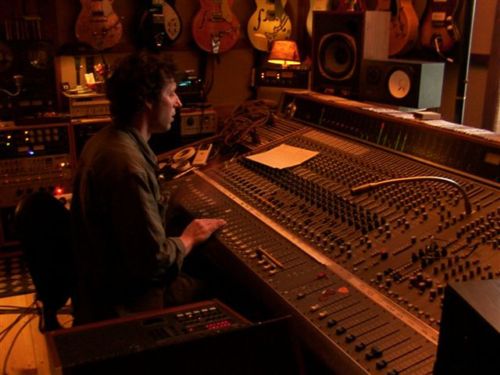
Chris Rival
The J.B. Groove
At rehearsal Zac, Ed (our original bass player) and I were jamming on the bass line to James Brown’s “Super Bad.” I listened back to a recording of the jam and, at some point I heard myself improvise the funky figure that opens the tune. I recognized the value of the figure and wrote the A and B sections around it. The C section in Bm is a melody that I came up with on the fly during another rehearsal.
When we started rehearsals for the CD Blendi, our current bassist, had just joined the band. He simplified and personalized the main groove and then came up with the terrific climbing line on the B section.
This tune features the largest number of separate guitar and amp parts I’ve ever recorded on a single tune which, in the grand scheme of things, still isn’t that many.
First we tracked the tune live with me playing my old strat through my Marshall 100 watt Super Lead and an old Marshall basket weave cabinet with 25 watt greenback Celestions and jumping from one part to another just as I normally do on gigs. This was a good take but I really wanted to hone the tone in for each little guitar part so I kept the live take and started experimenting with other tones and textures. The original solo was pretty insane and rather outside but I made a decision to try a more inside approach with a Hendrixy bent. The D’Pergo JK Classic has such a killer neck pickup tone that guitar was the natural choice for the solo. This is what we ended up with:
Funky part: Korina Gibson SG, Marshall studio15 combo amp
Tremolo melody: Gibson ES 330, Gibson GA-20 amp and a tremolo pedal. This set up doubles the original strat/ Marshall Fulltone Dejavibe.
Bridge (sus4 chords): old strat, Roy Goode amp/ Marshall cab.
Bm section: Korina SG, Roy Goode amp/ Marshall cab.
Solo: D’Pergo Strat, Roy Goode amp/ Marshall cab, MJM London Fuzz 2, Fulltone Dejavibe.
Promise
The first of three improvised solo pieces. I originally planned to do just one of these as I do live for an intro to “All of the Years” but I was in a groove the day I went in to track and just ended by playing all afternoon and recording everything. I took a theme and variations approach to the improvisation and gave consideration to melodic motifs from different tunes and even solos on the CD. This piece was the first thing I played after plugging in my 50 watt plexi Marshall and the old giant silver Fulltone Soulbender fuzz. We ran a Roland Space Echo into a ‘49 Fender Pro so the Marshall was dry and the Pro was wet.
8 to 11
I had to write a simple straight up rocker for the CD and narrowing down to prescriptive writing is very difficult for me. A few days before we were due to go back in the studio I sat down with my guitar and the opening melody statement popped right out. Thirty minutes later the tune was complete. We rehearsed it once and took it in to the studio thus it was the only track that wasn’t played live before the sessions. The title refers to Zac making fun of my southern accent when I pronounce certain numbers (the old outgoing message on my machine, to be specific). Naturally this grew into an idiotic road mantra that still occasionally resurfaces.
The melody and fills went down live through the 100 watt Marshall and I went back with a Telecaster to track the rhythm guitar part which is a blend of the Marshall and (mostly) a Vox AC30. The solo was pretty burning but too notey/ scaley for me so I went back later for some more passes. Unfortunately the Superlead starting generating strange overtones so I switched to the 50 watt which was sounding great. I used a MJM London Fuzz 2 and really rode the guitar volume for some nice changes in distortion texture on the fly.
I Am a Centaur
 The
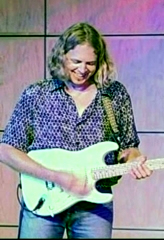
title of this tune is definitely a band inside secret! Zac plays a bit on every instrument it seems and during rehearsal one night he threw me this bass line. The simple bluesy A section melody is literally the first thing I played over it. I took that home and wrote the rest of the tune. The solo section is steaming with attitude and opens with my rudest tone ever - not for those that like it sweet and slick!
The
title of this tune is definitely a band inside secret! Zac plays a bit on every instrument it seems and during rehearsal one night he threw me this bass line. The simple bluesy A section melody is literally the first thing I played over it. I took that home and wrote the rest of the tune. The solo section is steaming with attitude and opens with my rudest tone ever - not for those that like it sweet and slick!
With the exception of the overdubbed keyboards this tune is completely live and one of my favorite performances on the CD. Two previous takes had been done with my strat, the Superlead, and the AC30. Take two was good but it seemed too polite and fusiony and the arrangement wasn’t happening.
Acting on a whim I pulled Chris Rival's ‘52 Telecaster off the wall and called a few changes in the arrangement.
This Tele is a strange guitar with a very small neck, worn frets, high action, microphonic pickups, and a dark but harmonically complex
tone. Just before we tracked the take Chris told me that if I pushed on the pickup selector a certain way it would break contact and
cause the sound to cut out. When I started the solo this was an effect I couldn’t resist! The band came together like magic
on this one.
For the solo I used the Fulltone Soulbender and an MJM Rocktavios octavia style pedal. The Marshall and the AC30 are running through
entire track. After the opening phrases I turned off the Rocktavios and then returned to it for the ride out at the end of the tune.
If you listen carefully you can hear the tele picking up the drums during the tag - another bonus for a once in a lifetime take!
About Rudy
Rudy was my beloved cat. She passed away last summer having spent all of her fifteen years with me. This second improvised solo is dedicated to her.
The descending triadic melody at the end is the one set part of this solo piece that also serves as an intro to “All of the Years,” the rest is improvised. For this I played the maple neck strat through the AC30 and used the same delay set up with the Space Echo running into the Pro.
All of the Years
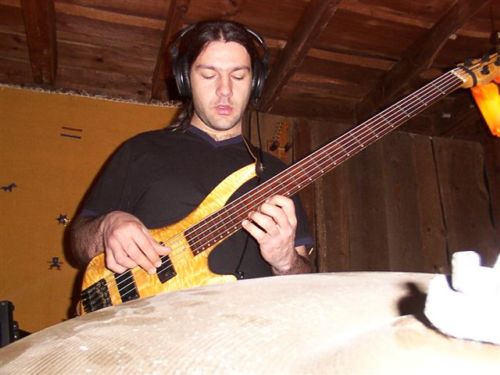
This is the first of three tunes on this CD (the other two being “Sister,” and “The New Imperial”) that I wrote during my last semester as a grad student at North Texas in 1995. Fred Hamilton, my teacher, asked what I wanted to do for my private lesson, so foolishly I volunteered to write a tune every week and play a special guitar department recital of the new music at the end of the semester.
Three of the tunes stood the test of time and after playing them live the conceptual nature of this music led naturally to the composition of the rest of the tunes. The harmonic motion of “Years” is very strange and complex in some places and quite functional and “normal” in others. In some ways it exemplifies my vision more than any of my other tunes compositionally and in my approach to the improvisation. The title refers to all of the years that have passed since Hendrix died yet every time I pick up my guitar I channel the inspiration he has given me.
I played my old rosewood board Strat straight into the Roy Goode JK custom head and the Marshall cab. I love the elegant Rhodes playing by Lefteris Kordis on this track.
Sister
Dedicated to my wonderful sister, Gabrielle. This is another harmonically complex tune. I wrote this with my friend, the great drummer Keith Carlock in mind and he played on the original demo recorded in ‘95. Unfortunately, though the first version of this tune had a mind boggling drum solo, it also suffered from a weak bridge so it went in search of a B section for ten years. Finally one day the music revealed itself and the tune was ready for the public. This is Zac’s favorite JKB tune (it was, after all, written for a drummer) and he plays great on it. Blendi plays upright on this tune and you can hear his bass creaking on the stand during his solo.
I played the maple neck Strat on this one. The clean tone was a combination of amps similar to what we used on Flipping Time: AC30, Fender Vibroverb, and a tweed deluxe with an echoplex running through it. The clean guitar was recorded live because I wanted the comping under my solo to be locked in yet spontaneous. The solo is the first take and was played immediately after the band take, while the vibe was still happening. I plugged straight into the Superlead and we added the delay during mix down.
Jacket Full of Bees
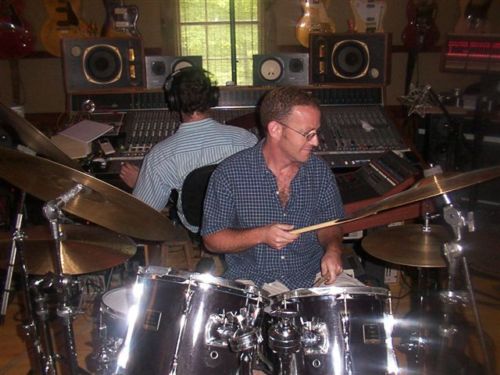
Stefan Dapergolas, the maker of D'Pergo guitars, named this tune. He said being around me was like having a jacket full of bees - that I have a laid back personality and I'm quiet in day-to-day life but when I start playing guitar everything gets stirred up and you are bound to get stung if you are not careful (or something to that effect).
Zac, Ed Spargo, and I were jamming on all kinds of insane things one evening. I recorded it all, listened back, and during one brief section a moment came together where Ed played that evil low bass groove, Zac locked in with him, and I played the “So What”-like chordal hits with the huge stacked fifth voicings a whole step apart. I knew that was a tune waiting to happen, so I transcribed it and started working on a melody and a B section. Though it sounds atonal, the wild A section melody was based on changes I originally wrote for a tune that was, in turn, based on the Coltrane tune "Satellite." I wrote the melody on the changes, put it over the ostinato bass, and tweaked the melody notes until it sounded right. The B section is in Ab mixolydian and Blendi brought it together with that killer slippery bass groove. The solo is conceptually atonal but still hovers around the key of D blues.
This was tracked live with the maple neck Strat, the Superlead, and the AC30. I used the MJM London Fuzz 2 for the solo. The guitar was knocked a bit out of tune during the solo so I punched in from the “AC/DC” chords at the end of the solo to the end of the track. You can hear the original with the feedback and the fast phrases running between the arena rock chords. The backwards guitar during the intro vamp and on the last chord is the real deal. We turned the tape over, I did a couple passes and we selected what to use during mix down.
In the Fields
This was one of those tunes that came to me all at once. I heard the tune in my head, sat down, and didn’t get up until it was finished. The title refers to childhood time spent on my grandparents Virginia farm which was called the “Home Place" (the title of the opening track of our other CD “Flipping Time.” ).
We decided not to include a solo section - the tune seemed perfect just one time through the head. I used the same guitar and amp set up as Sister.
The New Imperial
Many have asked about the meaning of this, the title track, and I’ve decided to keep it an inside secret
- known only to certain musicians I’ve worked with and a few audiences who have long since forgotten my between-song banter.
This tune is different in several respects. There is no bass player. Ken Clark plays left hand bass on the Hammond B-3. We wanted a very dry, contained sound for the drums, so Zac played some thuddy old Ludwigs in a small booth. I used a strange one-off guitar made by New England luthier Marty Flanders. It is chambered mahogany with a flat spruce top and P-90 pickups and looks kind of like a wide, flat Guild Bluesbird. I plugged it into an old Gibson GA-6 amp that Roy Goode modified rather heavily though it still maintains its fundamentally nasty barking dog tone.
Zulie
Another bass line from Zac that I took home, wrote a melody and added a third section, hence the title (Z)ac J(ulie)n. For a long time it had the working title of “Meters Rip” because it reminded us of a Meters tune but nobody could figure out which one.
People mistake this for a Telecaster but, once again, it is the old maple neck Strat. I am particularly proud of the bell-like clean tone on the melody and first half of the solo, which is the Vox AC30. For the distorted part of the solo I switched to the 100 watt Marshall with a Fulltone ‘70 fuzz and the Maxon delay.
Requiem (for Bottle)
Col. William M. “Bottle” Kasper was my Grandfather on my Father’s side. He passed away last summer while we were tracking this record. I was thinking of him when I improvised this mournful solo piece.
This was recorded using the same guitar and amp setup as “About Rudy.”
Mics and Mic Pre-amps
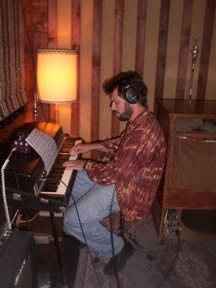 I kept track of some specific mic/pre info but I’ll keep it general. Neve, Bryston, Neotek, and Telefunken mic pres were used to taste and the difference between them was always profound as to the impact they had on tone. Usually Chris would switch between them, we would decide which pre sounded best for that particular application, and then I would forget to ask which pre we ended up with. Chris kept most of the info in tracking notes so I used those to fill in gaps in my memory.
For the Marshall cabinet Chris usually placed a Royer 121 ribbon mic about four feet from the cab through a Bryston preamp. For screaming fuzz tones ambient mics an old RCA 77 ribbon broadcast mic about 8 feet out and a little above the cab sounded great combined with a Neumann U-87 in the back of the room.
On the solo pieces and the "8 to 11' solo Chris used a Seinheiser 409 on the Marshall or the AC30, used the U-87 and an Earthworks TC30k as ambients, and a Neumann U-47 on the Pro.
The 409 and the U-47 on the AC30 and Vibroverb respectively were favorites for clean tones.
Every now and then the good old Shure SM-57 would end up on the Marshall cab. The sweet solo tone on "Sister" includes that mic.
Tracking Flipping Time
This installment honors the many requests I have had for a track-by-track rundown of guitars and amps on Flipping Time. It will have to suffice for me to say that all of the amps and guitars (with the exception of a historic reissue Les Paul) are old. The Marshall 4x12 cabinet (a particularly nice slant cab with original greenback 25 watt Celestions) and some of the amps belonged to Chris Rival, the engineer for the sessions.
Chris is an excellent guitarist, a great engineer, and a very patient man. He loves recording live and tracking loud guitars. Within a limited budget and time frame we put a fair amount of energy into mic placement to get the right tones to tape.
Because most of the performances were tracked live in the studio with the guitar amps in the same room as the drums, fixing mistakes and re-doing solos was not an option. Guitar bleed into the drum microphones contributed to the great live ambient sound of the CD, plus I wanted to remove the option of obsessively re-doing solos. Also, It is difficult enough to get guitar sounds without dealing with the brittle quality of digital recording so I decided to record to analog 24 track 2 inch tape.
Home Place
- Melody and rhythm guitar: Telecaster/ Vox AC30
- Solo: Telecaster/ 50 watt Marshall and Fender Super Reverb with a Fulltone Fulldrive 2 overdrive.
- Melody and rhythm were tracked live and the solo was overdubbed. The melody part was also doubled through the Marshall.
Flipping Time
- Les Paul/ 50 watt Marshall
I Know
- This piece is an improvisation based on thematic materials from And Now We Know, the tune that follows it. I did the chord solo first and then added the distorted melody guitar.
- Clean guitar: Strat/ AC30, Fender Pro Reverb, Tweed Fender Harvard with Echoplex.
- Distorted guitar: Strat/ 50 watt Marshall (on 11).
- For the echo on these two tunes we ran an echoplex into a separate amp - a tweed Harvard. The detuning effect you hear occasionally is the motor on the echoplex slowing down.
And Now We Know
- There are two guitar parts on this tune. The melody part was tracked live without echo after which I added the textural guitar with the echoplex rig.
- Strat/ AC30, Black face Pro Reverb, Tweed Harvard with Echoplex.
Ten Years Late
- Strat/ 100 watt Marshall Super Lead with Fulltone ‘70 fuzz, Fender Princeton Reverb
- Both amps were running side by side and, obviously, the Princeton was inaudible in the room! We brought it up in the mix for the cleaner chordal parts.
Footclappin’
- Tele/ Fender Deluxe Reverb, Fender Princeton Reverb
Talkin’ About What
- Strat/ 100 watt Marshall Super Lead (on 11)
Blues For Charles
- Strat/ 50 watt Plexi Marshall and Black face Super Reverb, Fulldrive 2 added on the solo.
Jackalope
- Strat/ 100 watt Marshall Super Lead with Fulltone ‘70 fuzz.
Bigger Than You
- Les Paul/ 100 watt Marshall Super Lead (on 11).
The Wayward Way
- This tune was written and recorded in the same day. The clean guitar was tracked live with the electric fretless bass. I went in, added a tube screamer to the same set up, and tracked the solo immediately. Later I had Marty Ballou replace the electric with an acoustic upright and double the melody on electric fretless. I also added another textural guitar.
- Strat/ Fender Princeton Reverb through a Marshall 4x12, Fender Bassman reissue. The amps are split with a tc Stereo Chorus which is on for the clean tones and off for the distorted guitar. For the overdrive I cranked the amps and added an old Ibanez ts9 Tubescreamer.
Check the Equipment section for more gear information.
Frequently Asked Questions
What is the deal with D’Pergo guitars? Do you work for them? Why are they so expensive?
D’Pergo guitars are, for what I seek in an instrument - beautiful tone with extreme string to string clarity and note
definition, natural resonance, balance, playability, sculptural artistic aesthetic - beyond a shadow of a doubt, the finest
Strat and Tele style guitars being made. If they weren’t I wouldn’t play them. Every knowledgeable good guitarist
who has actually played one has enthusiastically shared my opinion.
I do not work for D’Pergo but the builder, Stefan Dapergolas, has long valued my expertise and my ears when it comes
to these types of guitars so, in that capacity, I have certainly served as his artist consultant on a number of occasions.
When Stefan brought my original D’Pergo JK Classic to a gig in March of 2005 I was astounded by the clarity and woody
vintage character present in a guitar that had been completed that afternoon. I played it all night and took it out on a two
week tour the next day. I was further amazed by its stability and, to this day I’ve yet to adjust the neck on that guitar.
Since then Stefan has restlessly continued to refine every aspect of the guitars and my original instrument, that is stunning
by any standard (I still love it and play it every day), has been dwarfed many times over. In his quest he has spared no expense
in innovation, materials, and build time to improve the guitars, hence the price. Check the prices on vintage guitars for perspective!
You couldn’t touch a vintage guitar for the price of a D’Pergo but you could buy two or three mediocre higher production “boutique” instruments
that couldn’t begin to compare on any level.
How long should I practice every day?
As long as you can, just stay focused and on task. Write out a schedule and time your topics with a kitchen timer. Just fifteen minutes can be fine for some things. Use a metronome constantly and creatively (not just on quarter notes). Record yourself and listen back with critical ears to your time, intonation, tone, note choice, etc. Consider that virtually every great musician went through a period (or periods) in their lives when they practiced obsessively for eight or more hours a day. Hendrix was never without his guitar and Coltrane was known to practice during his breaks on gigs.
Are your solos improvised or do you “write” them?
All of my solos are improvised. I may conceptualize an approach, usually based around tone and/or style but each time I play a solo, live or in the studio, I am improvising.
Improvisation is becoming a lost art in rock guitar, particularly in high level instrumental music in which the technical demands are such that players feel solos have to be worked out in order to execute them and meet the expectations of their audience. Working out a solo so that it can be played perfectly and/or as fast as humanly possible is about athleticism not musical expression. Improvising a great solo used to be a point of pride among rock guitarists much as it is with jazz musicians. I would love to see a return to that aesthetic among players and listeners.
You are a schooled player. Did you learn to play that way in college?
No. When I went to school I had already played professionally for ten years and knew what I wanted to do as a guitarist. I went to college to learn to be a complete musician - to study jazz improvisation, composition, orchestration, and ear training, not guitar.
In the late ‘80s when I went to University of Miami the opportunities for learning to play jazz on the gig in the traditional way were already diminishing dramatically (gigs are almost nonexistent now). I wanted be in an intense environment with great faculty and student players who were going to kick my ass. Most of my learning was done at after hour jam sessions. As I got better I picked up jazz gigs and ended by getting the on the job training I was seeking all along. It has only been in the last few years that my teenage vision of raw psychedelic ‘60s rock guitar tones coexisting with jazz knowledge and musical command has truly taken shape in my own music.
Did you take private lessons as a child?
A few here and there but they were, for the most part, discouraging. I had one teacher who was convinced he was tormented by ghosts and I believe he may have been correct. I took a few classical lessons at age 12. My teacher was obsessed with my manicure and the position of my feet but not that concerned about the actual music. This was not particularly productive for an adolescent. However, his girlfriend had absolutely enormous breasts which fascinated me and kept me coming to lessons for a little while.
Have you had other private teachers outside of school?
My first great teacher was Peter Mayer in St. Louis, MO. When I was 18 I quit my band and moved up to St. Louis to live with my parents and practice for six months. My mother found Peter for me and he started me on the quest to becoming a musician, not just a guitar player. He exposed me to so much great music - Miles, Coltrane, Bill Evans, Wayne Shorter. Peter was a beautiful and elegant guitar player who played jazz on an old Strat. I have to say the inspiration he gave me completely changed my life. I was shocked to find out recently that he has been in Jimmy Buffet’s band for years and has been nurturing a career as an acoustic singer/songwriter. I’m sure, despite his change in direction, that he is as great a musician as ever.
When I lived in Austin, TX in the ‘80s I studied with a great jazz player named Clay Moore. Clay was tremendously helpful at nurturing my jazz vocabulary, forcing me to work on my reading, and exposing my musical weaknesses. Clay also got me a teaching gig at the New School in Austin and recommended me for quite a few playing gigs. We became good friends and drove all over Mexico in his ancient VW van. Clay now lives in Minneapolis, MN where he dominates the jazz guitar scene and teaches at Music Tech.
Are there any “new” guitar players that you admire?
Yes but they are not widely known. Originality is not rewarded with recognition in this day and age so you really have to seek these people out. Tim Miller is a good friend who also teaches at Berklee and, even if he wasn’t, he would be one of my favorite players. David Tronzo is an amazing slide player (also on the Berklee faculty) and a creative musician. Kurt Rosenwinkel is an amazing improviser and very unique player. For traditional George Benson/Grant Green type playing I’ve been enjoying listening to Rodney Jones lately.
Who makes the best effects?
For vintage style "Hendrix-y" pedals I like MJM - they always sound good. I use a lot of Fulltone stuff too. It may be coincidental but the Fulltone pedals I prefer tend to be fairly early editions. Certain Maxon pedals are good too.
What kind of speaker is in your Deluxe Reverb?
A Celestion “Blue” Alnico.
Is that a stock tremelo on your Strat?
Yes. See the section on Keeping Stratocasters in Tune.
Who are your favorite guitarists?
Jimi Hendrix, Jeff Beck, mid ‘60s BB King, Wes Montgomery, ‘60s Clapton, T-Bone Walker.